Quick answer
- Generative engine optimization (GEO) means making your business easy for AI tools to understand, trust and quote.
- AI tools favor businesses with clear service pages, consistent details across the web and real reviews.
- Answer customer questions directly on your site, in short, specific paragraphs.
- Good SEO is still the foundation: GEO builds on it, it doesn’t replace it.
Picture a busy mom in Katy. Instead of typing “pediatric clinic near me” into Google, she opens ChatGPT and asks, “Which pediatric clinics near Katy are open on Saturdays and take Medicaid?” A few seconds later, she gets three names. She books with one of them.
Was your business on that list?
That’s the question behind generative engine optimization, or GEO. It’s the newest piece of being found online, and the good news is that it rewards the same things good businesses already do: being clear, being consistent and being genuinely helpful.
What is GEO, really?
Traditional SEO helps your website rank in Google’s list of blue links. GEO helps your business get mentioned, summarized or recommended inside AI-generated answers: ChatGPT, Google’s AI Overviews, Perplexity, Gemini and the AI features built into phones and maps.
These tools read huge amounts of web content and try to give one confident answer. To include you, they need to understand three things quickly: what you do, who you serve and why you’re a trustworthy choice.
Why this matters for small businesses now
AI answers often show just a handful of options. That’s a challenge if you’re invisible, and an opportunity if you’re not: a small Houston practice with a clear, well-structured website can stand next to much bigger names, because AI tools care more about clarity and trust than about ad budgets.
6 ways to help AI tools recommend you
1. Give every service its own clear page
One page that lists “Services: everything!” is hard for anyone to understand, humans or machines. A dedicated page for each service, with a plain headline like “Pediatric Sick Visits in Pearland,” tells AI exactly when to mention you.
2. Answer real questions in the first sentence
AI tools love content that answers a question directly. Start sections with the answer, then add detail. For example: “Yes, we accept Medicaid at all three locations. Here’s what to bring to your first visit…”
3. Keep your business details identical everywhere
Your name, address, phone number, hours and services should match on your website, Google Business Profile, Yelp, Facebook and directories. Inconsistent details make AI tools less confident, and less confident tools don’t recommend.
4. Collect reviews that mention specifics
“Great service!” is nice. “Dr. Patel saw my son the same day and explained everything” is far more useful, because it tells AI what you’re known for. Ask happy clients to mention the service they used.
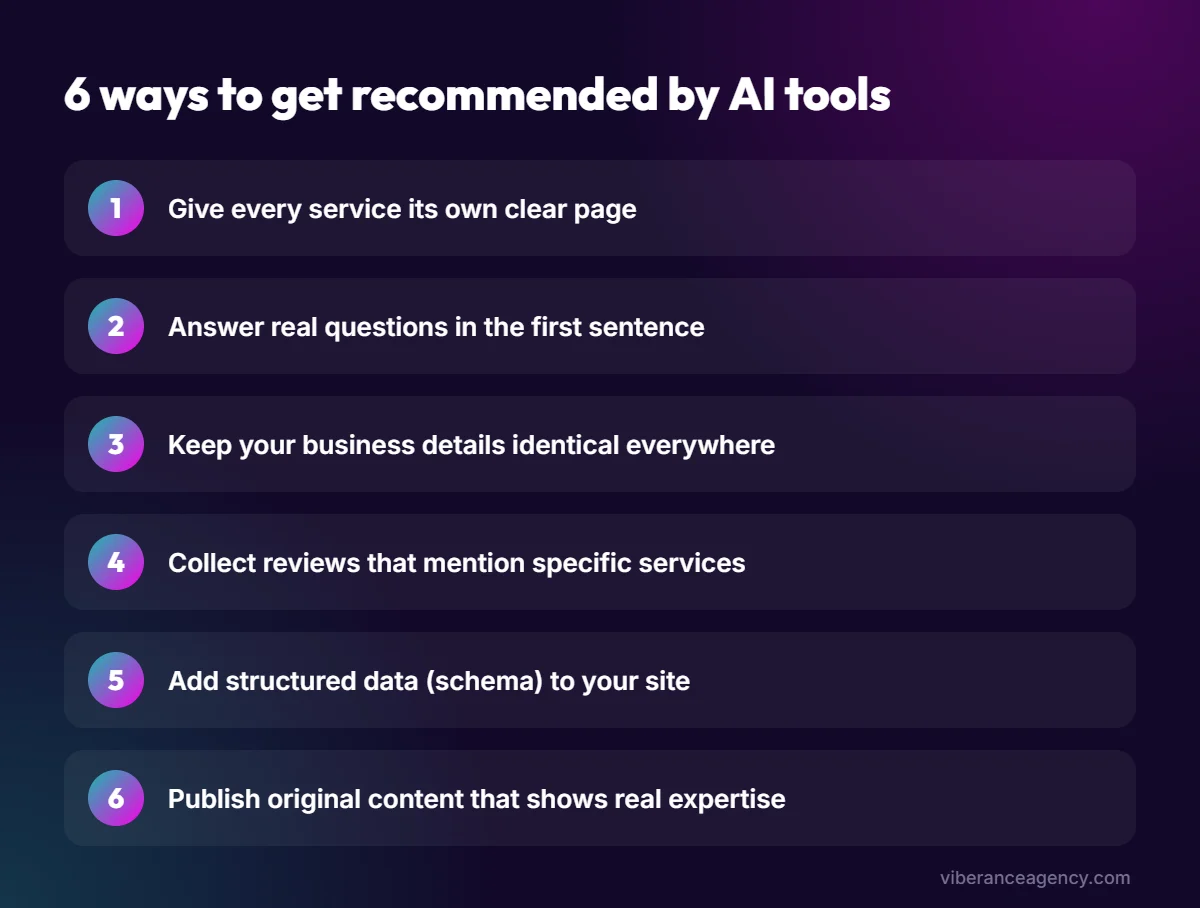
5. Add structured data (schema)
Schema is a small block of code that labels your content for machines: this is a business, this is our address, these are our FAQs. It’s invisible to visitors but helps search engines and AI tools read your site accurately. We add it to every site we build.
6. Show your expertise with original content
Generic blog posts copied from the internet won’t stand out. Share what you actually know: real examples, local details, behind-the-scenes process, results from your own work. That kind of content is exactly what AI tools look for when they need a trustworthy source.
A real example
For MyCHN.org, a community health network in the Houston area, we combined a patient-focused redesign with ongoing SEO, FAQ content and structured answers. Since January 2022, monthly search impressions have grown 9.5×, from 213K to more than 2 million, and the site has earned more than 1.2 million clicks from Google. That same clear, structured content is what AI tools draw on when they answer questions about local care.
What not to do
- Don’t stuff keywords. AI tools are good at spotting text written for robots instead of people.
- Don’t publish dozens of thin AI-written posts. Quantity without substance can hurt trust.
- Don’t ignore your Google Business Profile. It’s one of the most important sources AI tools check for local businesses.
Where to start this week
Pick your most important service. Make sure it has its own page, a clear headline, a short answer to the top three questions customers ask, and matching details on your Google profile. That one hour of work helps with Google, Maps and AI answers all at once.
Want a second set of eyes? Download our free 2026 SEO & AI Search Checklist, or see how our SEO & GEO service works.
Frequently asked questions
What is generative engine optimization (GEO)?
GEO is the practice of making your business easy for AI tools like ChatGPT, Google AI Overviews and Perplexity to understand, trust and recommend in their answers.
Is GEO different from SEO?
GEO builds on SEO. Strong SEO basics like clear pages, fast loading and good content are still the foundation. GEO adds a focus on direct answers, consistent business details and structured data.
How long does it take to show up in AI answers?
It varies. Fixing your business details and service pages can help within weeks, while building authority through content and reviews is an ongoing process.
Can a small business compete with big brands in AI search?
Yes. AI tools value clarity, relevance and trust. A local business with clear service pages, consistent details and specific reviews can be recommended alongside much larger companies.
Ready to put this into action? Book a free strategy call and we’ll look at your website together.